AI and LinkedIn ·
Inbred generative AI is already here
Do you know the Whittakers? The question sounds odd as a starting point for talking about artificial intelligence, but their story helps explain one of the most uncomfortable risks of the moment: what happens when a system starts reproducing inside its own limits, feeding again and again on the same material until it deforms it.
Let me tell you this family's story first, and then we will connect it with what is happening on the internet right now.
By Mario Pérez
Who the Whittakers are
The Whittaker family became known in 2004, when the photographer Mark Laita reached them while travelling across the United States with Created Equal, a project dedicated to portraying very diverse social, cultural and human realities, including people living at the margins of public visibility. That work took him to Odd, a small rural community in Raleigh County, West Virginia, where he found a family who had spent years living in isolation, poverty and exposure to their neighbours.
As Laita has recounted, on arriving in the area he was met with insults and threats from neighbours who wanted to stop him getting close. The reaction had a clear reason. The family had already been watched, discussed and ridiculed by strangers. In a setting like that, anybody with a camera could become another gaze ready to treat them as a curiosity. The neighbours' protection did not make the scene any less hard, and at the same time it explained the initial rejection of somebody arriving from outside to take photographs.
The first impression was disconcerting. Before seeing the family, Laita heard barking and strange noises that kept him alert in case a dangerous dog was nearby. He soon understood those sounds came from Ray Whittaker, one of the most recognisable members. Ray communicated with grunts, barks and gestures, in a mixture hard to classify from outside. In the later Soft White Underbelly videos his presence becomes almost impossible to forget, because it forces the viewer to confront a form of communication that falls outside the usual categories.
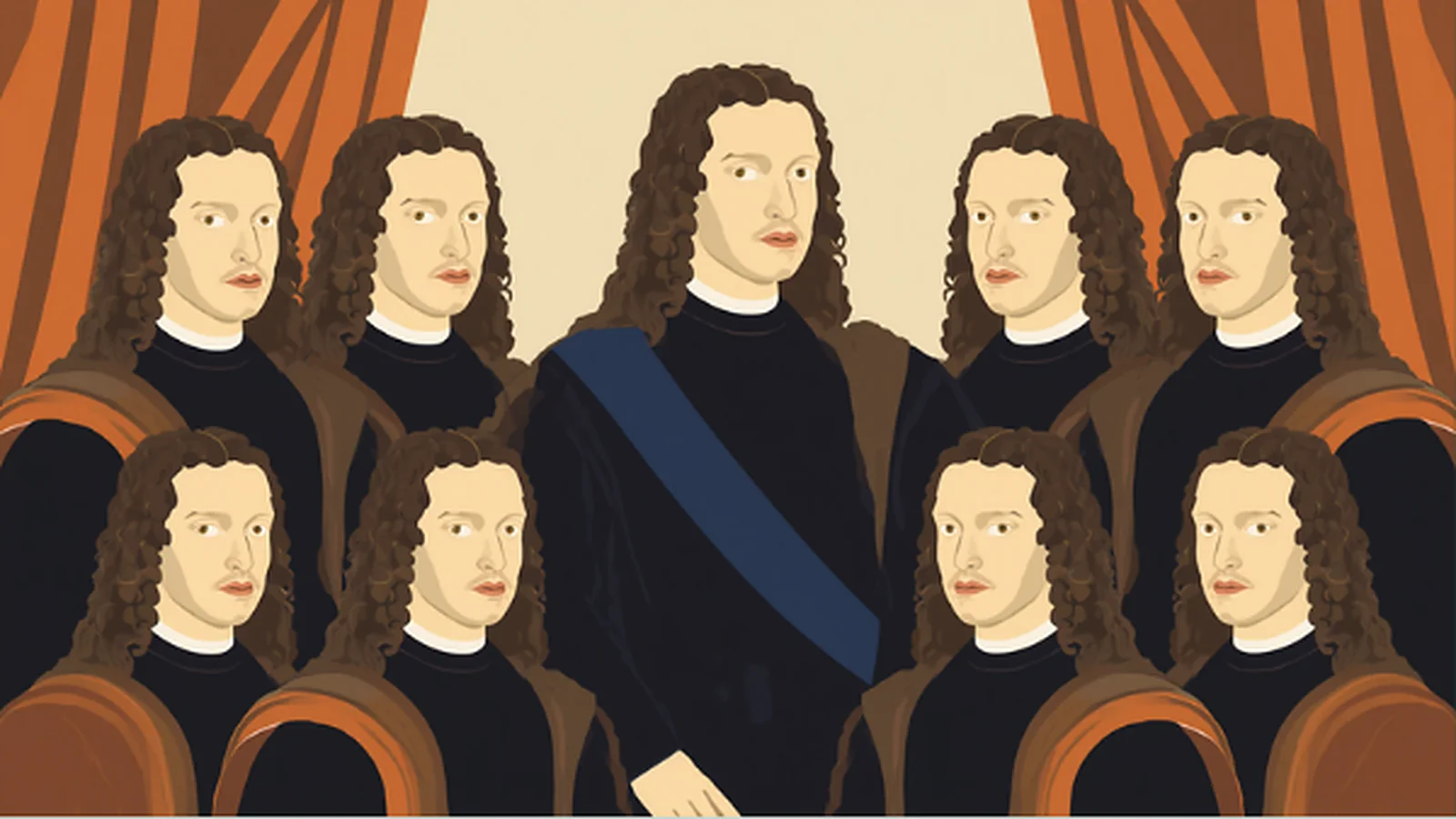
Ray walked Laita to the house, and there he met much of the family core: Betty, Lorene, Ray, Larry, Kenneth and Timmy, Lorene's son and nephew to the rest. All of them had evident physical deformities, cognitive delays and severe communication difficulties. They also shared an unsettling physical resemblance, as if their faces were variations on one repeated structure. Laita had arrived at an inbred family whose history of relationships between close relatives goes back, according to the available genealogical reconstructions, to the nineteenth century.
The passing years, the isolation and the incestuous relationships had made the Whittakers a family trapped in its own genetic code, condemned to repeat the same limitations until the family inheritance became a visible form of deterioration. The image is hard, even uncomfortable, and precisely for that reason it works as a metaphor for another process already under way on a digital scale.
The loop: an AI feeding on AI
Artificial intelligence feeds on the content published on the internet, and at the same time the internet fills up every day with content generated by artificial intelligence. Every text written by AI and uploaded to a website, every mass produced product description, every SEO article manufactured to rank without adding much, every synthetic image uploaded to a stock library, every video with an artificial voice, an artificial script, an artificial face and artificial emotion becomes part of the digital ecosystem. And part of that ecosystem ends up, directly or indirectly, feeding new models.
That is where the loop begins. AI learns from the internet, the internet fills with AI and the next generation of models learns again from that ever more synthetic internet. The Whittaker family now lives in a network saturated with self reference, far from any West Virginia mountain. A system tangled in its own outputs until content production becomes a white smear of texts, images, videos and songs that look different while sharing the same statistical DNA.
Model collapse: when the system runs out of oddities
This phenomenon is usually called model collapse. Researchers at Oxford, Cambridge and other institutions have studied it in recent years, and the underlying idea is simple. When models are trained indiscriminately on content generated by earlier models, they start losing parts of the original data distribution. Put plainly, the system gradually runs out of oddities. It loses the edges, the less frequent cases, the less predictable ways of representing reality, the small voices, the crooked structures and the human errors that sometimes hold more life than a perfectly optimised sentence.
That detail matters, because intelligence also depends on preserving the improbable. A model trained on too much synthetic production can become flatter, more predictable and more convinced that the world resembles the average of its own earlier outputs. The degradation does not have to arrive as a spectacular failure. It can appear as excessive correction, as a normality with no texture, as a growing ability to produce acceptable content alongside a shrinking ability to produce anything genuinely situated, odd or memorable.
We are already seeing it in texts that sound the same whether they discuss Kafka's metamorphosis or Cristiano's latest haircut. Also in images representing the same thing in identical ways. Ask ChatGPT for a photo of an astronaut and then run a reverse search on Google Images. And in music and videos with less original in them every day and more of the tinned product, however hard you work at prompting and reprompting.
The great flattening: why your whole industry starts to sound the same
The danger: that everything starts to look correct
The most dangerous part of this process is that everything starts to look correct. Correctly lit, correctly written, correctly structured, correctly neutral, correctly optimised and correctly dead. AI generated content can produce beauty, usefulness and knowledge, and it does so daily. The risk appears when its mass production becomes the new ground on which we train, search, write, decide and remember. At that point we stop talking about individual tools and start talking about an ecosystem.
One AI generated text can help you organise ideas. A billion AI generated texts can turn the internet into a lukewarm soup of functional sentences. One AI generated image can be a creative solution. Millions of AI generated images can narrow the collective imagination until every astronaut, every happy child, every wise elder and every possible future looks cast from the same mould. The repetition becomes so abundant that we end up calling its average reality.
Generative models work by predicting patterns. They learn what usually comes after what, which structure resembles an answer, which kind of image looks valid and which combination of words sounds reasonable. That ability makes them useful, and also fragile when the material they learn from starts being contaminated by their own outputs. When a model learns from humans it receives contradiction, noise, style, clumsiness, accent, error, brilliance, context and oddity. When it learns from other models it receives an already digested version of all of that, with less edge, less friction and less world.
Generative inbreeding
That is why the idea of generative inbreeding fits so well. In genetics, inbreeding reduces diversity and raises the risk of certain limitations repeating. In AI, recursive training on synthetic content can reduce informational diversity and amplify errors, biases, clichés and impoverished patterns. AI starts reproducing with its own family, and the deformities appear somewhere else: in the language, in the imagination, in search results, in articles nobody has thought through, in images nobody has seen before but everybody recognises instantly, and in answers that look intelligent because they learned to perfection how an intelligent answer sounds.
That is inbred generative AI's single tooth: its perfect product smile, its drool falling on a clean screen, its capacity to welcome us into a world where everything looks new for three seconds and repeated by the fourth.
What food we are giving it
The important question has already changed. AI is inside the creative, productive, educational, business and cultural process. The useful debate is about knowing what kind of food we are giving it and what kind of world we want it to hand back. If all new content is produced looking inwards, AI will end up compressing reality. If every company publishes articles with the same structure, the same subheadings and the same empty authority phrases, the network will fill with textual packaging. If every creator uses the same prompts, the same styles, the same visual tricks and the same references from Midjourney, DALL-E, Runway or Sora, creativity will become recognisable to the point of boredom.
It is also worth avoiding the simplistic reading. Synthetic data proves useful in many fields: medicine, simulation, robotics, privacy, specific training or scenarios where real material is missing. The problem arrives when the synthetic replaces contact with fresh, human, diverse and verifiable data entirely. The way out involves preserving the real, with AI inside the creative and technical process, as one more tool.
We need to preserve the real
For this not to get out of hand, several things are needed. Provenance, to know which content comes from humans, which comes from machines and which has been mixed, edited or synthesised. Traceability, so systems do not end up training blindly on their own remains. And above all, data that is situated, contradictory, imperfect and diverse: voices writing from a place of their own, images breathing outside the same statistical womb, music after something more than pleasing the average and videos born of a gaze rather than an exact retention recipe.
The internet was built with disorderly human contributions: absurd forums, personal blogs, endlessly long comments, clumsy tutorials, badly framed photographs, songs recorded in a bedroom, contradictory reviews, incomprehensible memes, obsessive essays and threads of odd people explaining odd things for years in exchange for nothing. That was a jungle. Now we risk turning it into an industrial nursery of synthetic content: cleaner, faster, more abundant and poorer.
Inbred generative AI is already here
The Whittaker family went viral because there was something brutal about looking at an extreme consequence of enclosure: a group of people who, over generations, had been trapped in their own biological, social and territorial circuit. Generative AI runs a similar risk, less bodily and far more widespread: getting trapped in its own statistical circuit. An intelligence trained by its own descendants. A digital culture looking at itself until it runs out of world. A network barking because it has forgotten other ways of speaking.
Inbred generative AI is already here. It barks at you, smiles with a single tooth and, drooling, welcomes you in. The question is whether we are going to shake its hand or whether there is still time to teach it something that does not come from itself.